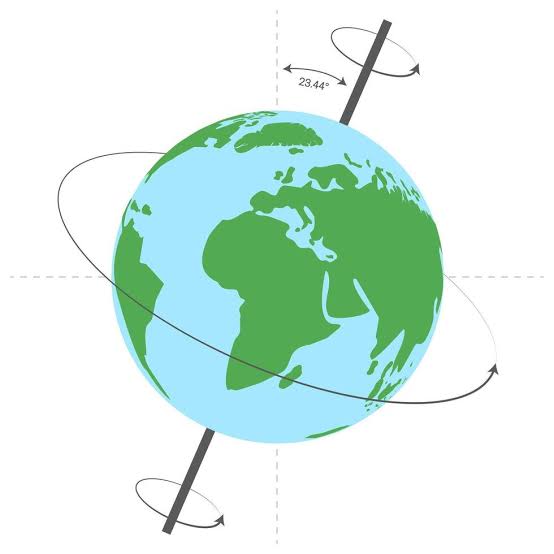
The actual time it takes for one revolution is 365.242190 days. This amounts to 365 days, 5 hours, 48 minutes, and 56 seconds. We round that extra bit beyond 365 to 0.25 (~6 hours) and take an extra "leap day" on Februrary 29 every 4 years (but skip it every 100 years) to keep the calendar from getting out of sync with the seasons. The people who decide such things have added a leap second now and again as needed to further fine tune the synchronization.
It is a good thing that the Earth rotates on its axis. This means we have day and night every 24 hours. Temperatures on the Earth would be much more extreme if one side always faced the sun, and the other side always faced away. The moon, in contrast, is "tidally locked" with the Earth so one side always faces us, and the other side always faces away. While there is a "near side" and a "far side" of the moon, there is no permanent "light side" or "dark side" of the moon (except for the Pink Floyd album).
Because of the influence of the moon's gravitational pull on the Earth, melting polar ice (which shifts mass from the poles towards the equator) and the dynamics of the molten core, which is gradually cooling, the Earth's spin is slowing measurably. The slowing varies but ranges between 1.7 - 2.4 milliseconds per century. That doesn't sound like a lot, but when dinosaurs roamed the Earth 65 million years ago, the Earth's day was only 23 hours long.
Why is this important? Accuracy in timekeeping is important to modern humans because we require close accuracy for things like computing interest rates, using GPS, etc. Now that we can communicate with people instantaneously all over the world, the same moment in time may be day or night depending on where a person lives so, for the purposes of commerce and travel, humans developed time zones, the International Date Line and Greenwich Mean Time.
One might assume that since the rate of Earth's rotation (spin) is relatively constant, we would have 12 hours of light and 12 hours of darkness each day. But we know that in Winter, days are shorter, and nights longer. In summer, days are longer, and nights shorter. But this is also not entirely true. In the Southern Hemisphere, seasons are reversed. At the equator, days and nights are almost exactly 12 hours long all year and, at the poles, the most extreme differences in day/night length occur. Why does the sun never set at the North Pole in mid-summer, and why does the sun never rise above the horizon in mid-winter? Why do we have seasons?
If you were to ask the average person why we have seasons, you might get a variety of answers. All of the following are true, but one is most important. 1) The Earth's orbit around the sun is slightly elliptical rather than perfectly circular, so there are times during the year when the Earth is closer to, and farther from, the sun. 2) The Earth's axis is tilted about 23.44 degrees off of vertical. 3) The Earth has a regular wobble in its orbit and this angle varies between 22.1 and 24.5 degrees on a 41,000 year cycle. (The theory is that a Mars sized object struck the proto-Earth, forming the moon and knocking the Earth off of its vertical axis. The axial tilt is the most important of these three.)
Now, let's zoom out. If we position the Earth on the left side of the Sun as shown in the picture below, then it is mid-summer in the Northern Hemisphere. The North Pole is tilted toward the sun, and the South Pole is tilted away from the sun. If the Earth was positioned on the right side of the Sun as shown in the picture below, the South Pole is tilted toward the sun. This is mid-summer in the Southern Hemisphere and mid-winter in the Northern Hemisphere. Half way between these two positions are the Vernal (Spring) and Autumnal Equinoxes where the day and night are equal in length. Equinox = "equal darkness."
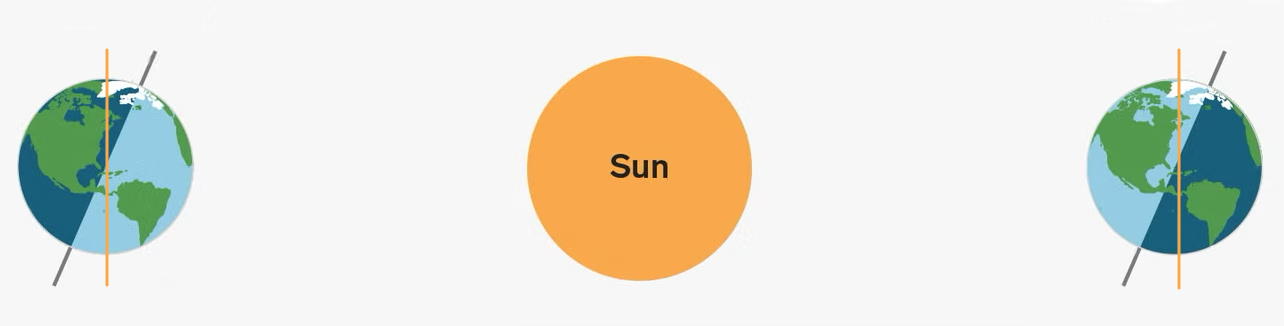
In the Northern Hemisphere, we think of December-February as the coldest months. However, in the Southern Hemisphere, these are the hottest months. We tend to have a Northern-Hemisphere-centric view of things, but the seasons are reversed depending on which side of the equator you live. Maps are, by convention, drawn with the North facing up, but of course that is entirely arbitrary.
The Earth's four seasons, Spring, Summer, Fall, and Winter are divided into three months each. In the Northern Hemisphere, Winter is December, January, and February. Spring is March, April and May. Summer is June, July, and August. Fall is September, October, and November. But these divisions are somewhat arbitrary (months have different numbers of days) and, in the Southern Hemisphere, the seasons are reversed. The longest day (shortest night) of the year is called the Summer Solstice. The shortest day (longest night) of the year is the Winter Solstice. In between, are the Vernal (Spring) Equinox, when days are lengthening until day and night are equal in length, and the Autumnal (Fall) Equinox, when the days are shortening until day and night are equal in length. They occur around the 21st of the season's first month, plus or minus a day.
| Northern Hemisphere | Southern Hemisphere | Month | |
| Winter | Summer | December | Solstice |
| January | |||
| February | |||
| Spring | Fall | March | Equinox |
| April | |||
| May | |||
| Summer | Winter | June | Solstice |
| July | |||
| August | |||
| Fall | Spring | September | Equinox |
| October | |||
| November |
One wonders how some of these arbitrary divisions that we take for granted came about. Some may be based on natural world cycles. Are there 360 degrees in a circle because a year is ~365 days long? Is a month based on the 29.5 day cycle of the moon's phases? Why does a week have 7 days? Why does a day have 24 hours? The theory is that the Sumerians used Base 12 math, using the 3 digits on each of 4 fingers for counting. Why are seconds and minutes measured in 60s? The Babylonians used a Base 60 (a multiple of 12) math system. Is our modern number system based on 10 because we have 10 digits to count on? There is even a theory that the distance between modern railroad rails goes all the way back to the Romans!